
When brand founders or ecommerce directors ask me whether they should invest in specialized SEO services, their hesitation usually comes down to a very common assumption:
“Our website already has a strong domain authority, and our product pages are already live. Do we really need to put extra budget into page-level SEO? Won’t traffic and sales just grow on their own over time anyway?”
It’s an entirely understandable mindset. When you’ve already built up a healthy, authoritative domain, it feels counterintuitive to think that an individual product page needs special attention. The underlying logic is simple: “If the site is already strong, does doing SEO versus doing nothing actually make a noticeable difference?”
Working on technical and commercial SEO for scaling ecommerce brands, however, reveals a stark reality: domain authority alone does not automatically translate into page-level traffic, let alone revenue.
This exact scenario played out with a recent client case. Initially, this specific high-ticket appliance wasn’t positioned as a core focus in their product catalog. But following a shift in their commercial strategy, the client decided to elevate it into a primary money page. Even though the URL had been sitting on their high-authority domain for a long time, we checked the baseline and found a classic blind spot: because no targeted optimization had ever been done, the page was essentially a ghost town.
To answer whether ecommerce SEO is truly worth the investment, let’s look at what actually happens when you stop leaving an established money page to chance and start treating it as a targeted search asset.
The Pre-Optimization Baseline: High Domain Authority, Zero Impact
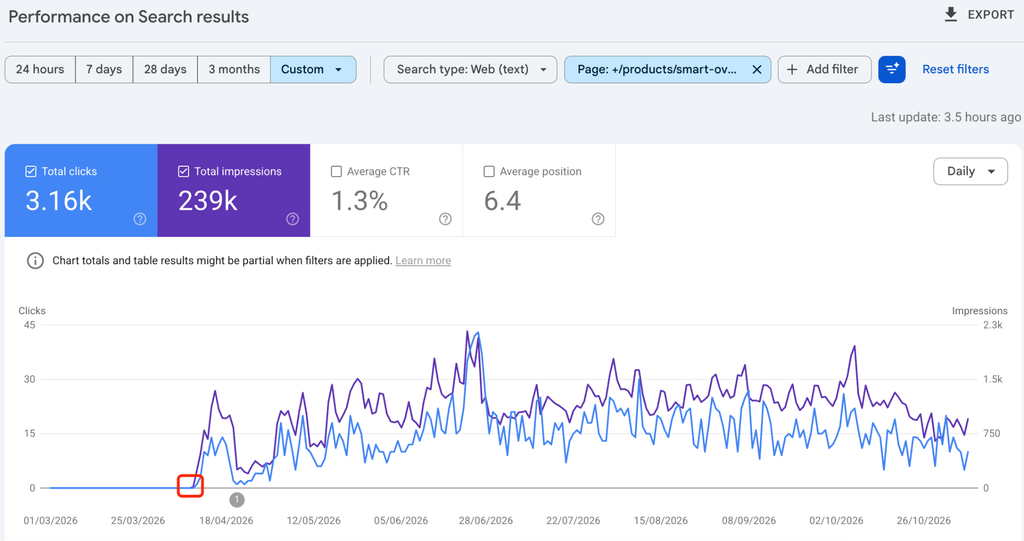
Before we launched our targeted optimisation sprint on April 1st, 2026, the product page sat on an established, high-authority domain. Yet at the individual URL level, the data tells a stark story:
- URL Rating (UR): 0
- Organic Clicks (GSC): 0
- Impressions: 0
- Ranking Keywords: 0
Search engines did not automatically reward this URL simply because of the parent domain’s footprint. Without deliberate intent disambiguation, keyword structuring, and technical content mapping, it remained an invisible “ghost page.”
Six-Month Performance Growth: Q2 vs. Q3 Execution
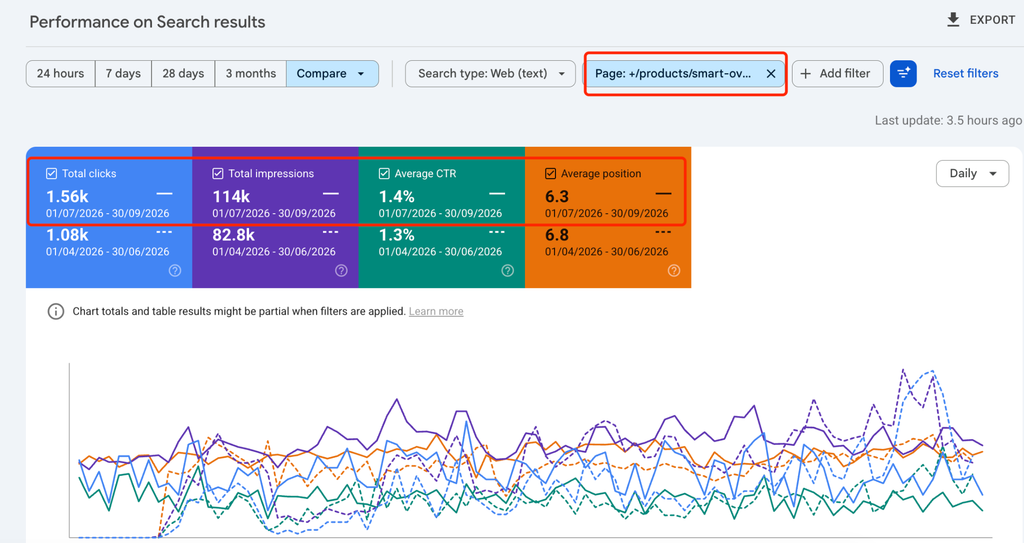
| Metric | Q2 Foundation (Apr – Jun) | Q3 Scaling (Jul – Sep) | QoQ Growth |
| GSC Organic Clicks (3-Mo) | 1.08K | 1.56K | +44.4% |
| GSC Impressions (3-Mo) | 82.8K | 114.0K | +37.7% |
| Ahrefs Monthly Traffic | 630/mo | 749/mo | +18.9% |
| URL Rating (UR) | 0 | 15 | +15 Points |
By executing a structured optimization roadmap over two consecutive quarters, we shifted this single URL from complete dormancy into a predictable organic growth engine.
Key Ranking & Indexation Milestones
Rather than relying on vague visibility metrics, the optimization delivered three concrete structural wins:
- From Zero Indexation to Generic Keyword Expansion: Before optimization, the page had 0 ranking keywords. Post-optimization, search engines not only indexed the page but continuously expanded its coverage across generic and long-tail commercial search terms, building a broad traffic base that continues to grow steadily.
- High-Volume Brand Category Driver: Captured Position #1 for the high-volume commercial query, dominating the highest-converting brand-category entry point for this product line.
- Exact-Match Flagship Model: Secured Position #1 for the primary transactional term. By resolving search-intent ambiguity, we helped search engines distinguish the exact flagship model from secondary variations, attracting ultra-high-intent buyers.
Calculating Hard ROI: The Direct & Indirect Financial Impact
When evaluating why invest in SEO services for ecommerce, the conversation must move past vanity rankings and look directly at commercial returns. Let’s break down the revenue generated by this single page over the 6-month review period:
Organic Sales Breakdown
- Total Organic Clicks (Q2 + Q3): 2,640 high-intent clicks
- Organic Search Conversion Rate (CVR): 1.14%
- Average Product Price (AOV): $200
- Direct Revenue: 2,640* 1.14%*$200 = $6,019.20
A Note on Attribution: To keep our metrics conservative, this $6,019.20 figure counts only direct, strict last-click conversions from organic search results. It completely excludes the additional indirect revenue generated through direct site visits, assisted ad conversions, or repeat customer value that this organic visibility inevitably fueled over the same period.
[ Unoptimized Money Page ]  --> UR 0 | 0 Clicks | $0 Revenue
                                    ? (Targeted Page-Level SEO)
[ Optimized Money Page ]    --> UR 15 | 2,640 Clicks | $6,019.20 Direct Sales
Why Organic CVR Outperformed the Site Average (1.14% vs 0.52%)
You may wonder how come the conversion rate could be that high. I checked my Shopify website, it’s maybe only zero point something. Let me explain.
Across all acquisition channels, the site’s all-time baseline conversion rate sits at 0.52%. The organic search channel on this product page delivered a 1.14% CVR—more than double the site-wide average.
This performance aligns with consumer search intent research. Users arriving via organic search demonstrate active purchasing intent rather than passive browsing. By aligning the page content with exact transactional keywords, we ensured the traffic landing on the URL was ready to buy.
The Spillover Effect: Direct Sales & Customer Lifetime Value
Beyond immediate click-to-sale attribution, organic traffic contributes to overall channel health in two ways:
- Assisted Direct Sales: Industry attribution models (Google Marketing Insights) show that high-ticket appliance shoppers rarely purchase on the first impression. They discover the product via organic search, bookmark or record the model name, and return later via Direct Traffic to check out.
- Higher Retention & LTV: Consumer studies (McKinsey & Company) indicate that customers who discover a brand through active organic discovery exhibit stronger initial trust, yielding a 15–20% increase in Customer Lifetime Value (LTV) and repeat order rates over time.
SEO as a Compounding Asset vs. Paid Acquisition
Another critical distinction to keep in mind when planning budget allocation is the long-term asset value of organic optimization compared to paid ad campaigns.
- Paid Search / Social: Works like a tap. Traffic streams immediately when you fund the campaign, but drops to absolute zero the moment ad spend halts.
- Ecommerce SEO: Works as a compounding digital asset. Once a money page reaches a UR of 15 and holds Position #1 for high-volume keywords, rankings remain stable. The marginal acquisition cost per visitor trends toward zero while continuing to generate baseline sales quarter after quarter.
Strategic ecommerce page optimization delivers three core advantages:
- Unlocks dormant domain authority and transforms zero-traffic URLs into measurable sales drivers.
- Attracts high-intent traffic that converts at a significantly higher rate than generic channels.
- Establishes stable, multi-quarter organic visibility that continues to deliver ROI long after the initial sprint is complete.
To Do or Not to Do SEO?
Of course, in a real-world business environment, you can never perform a perfect split-test on the exact same domain—running active SEO on one URL while leaving it completely untouched in a parallel universe to measure the absolute difference.
However, as this 6-month data demonstrates, looking at SEO through the lens of cold, hard revenue proves that doing it versus doing nothing yields two vastly different commercial realities.
Ultimately, rank-building is not about tricking an algorithm. The core principle of Google has always been simple: to deliver the highest-quality content and best user experience for searchers. When we choose to optimize a dormant money page, we aren’t just optimizing code; we are making our site genuinely more helpful for the consumer landing on it.
If we are playing in Google’s ecosystem, standardizing this quality is how we collectively build a better web. It’s honestly a bit unfortunate that so many ecommerce brands still treat search optimization as an optional, secondary channel.
This brings us back to the core question: why invest in seo services for ecommerce in the first place? Because page-level search optimization isn’t an afterthought—it’s how you unlock dormant domain equity, turn idle web assets into high-converting commercial revenue, and build a stable, long-term organic engine that keeps paying dividends long after the initial sprint is complete.

Leave a Reply