
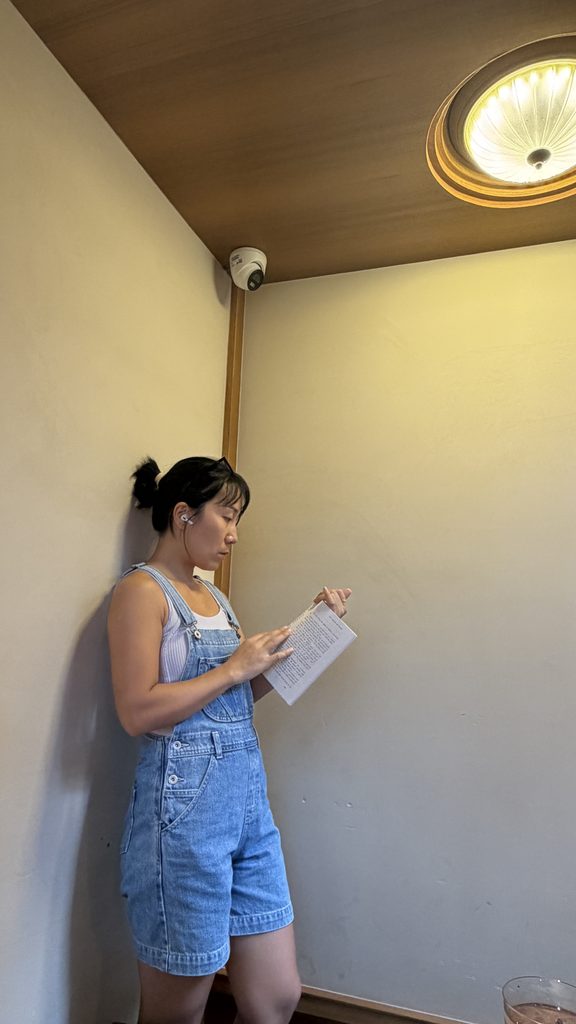
We completed the reading challenge, although I was still reading during the first half of our session. In the end, we did manage to finish the book before Nina left.
I really enjoyed that cozy corner—the soft light falling over my pages while Nina and Chelsea talked about books and life. It felt like they were both well-prepared before the session, having already finished the reading, while I was the only one who hadn’t completed it and ended up starting to read during the meeting itself. Quite fitting for my personality, I guess.
I suppose we all have moments like that in a day—sometimes we are aligned, sometimes slightly out of sync.
Finishing the second half of The Sirens of Titan felt a bit hectic, to be honest. It almost felt like the pace of the characters’ lives in the book accelerated as we read faster toward the end.
Different Ways Of Reading The Same Book
As always, Chelsea went deeper after finishing the book. She did more research and brought back a clearer and more structured understanding of both the novel and the author.
She became especially interested in Kurt Vonnegut, who seems to have lived a very versatile life with many interests and a deep way of thinking about existence. Nina shared that curiosity as well, and both of them seemed genuinely excited about exploring more of his work.
I, on the other hand, was quite tired that day. I only finished the book right before our group discussion, so my mind was still sitting with the unexpected ending.
According to Chelsea’s research, Vonnegut sees life as something relatively linear, without too many abrupt emotional or structural shifts. But my reading of the book felt quite different.
To me, the ending felt abrupt and somewhat disconnected from the beginning.
I really enjoyed the first half of the book. But in the second half, I started to feel a sense of narrative loss—especially in the parts involving the three Titan girls. It felt like the original hook of the story was no longer the focus, and the narrative moved forward without much explanation or emotional resolution.
Because of that, I honestly felt a bit disappointed with the ending.

The Moment We Didn’t Agree
Chelsea and Nina seemed to align more with Vonnegut’s own idea that his writing reflects real life—ordinary, steady, and without many dramatic ups and downs.
From my perspective as a reader, I see it differently. I feel that life does have ups and downs for everyone—we just don’t always notice or pay attention to them in daily life, which is why it can sometimes feel plain or uneventful. And I also believe that a good story needs those rises and falls. That’s what keeps the reader engaged.
So when the book moved toward the ending, it felt like some of the initial hooks were dropped quite abruptly. For me, that’s when I started to lose interest in the narrative.
That was the first real moment where our interpretations as Falliannas clearly diverged.
It was difficult to convince each other, not because anyone was right or wrong, but because we were clearly reading the same story through different lenses.
The Line That Brought Us Back Together
But interestingly, we did share the same emotional reaction to one line in the book:
“It took us that long to realize that the purpose of human life, no matter who is controlling it, is to love whoever is around to be loved.”
In that moment, despite all our differences in interpretation, we were on the same page emotionally.
I really liked that feeling—when a book somehow creates a shared response, even if everything else feels different.
What The Disagreement Made Me Think About
What surprised me is that the disagreement didn’t fade away. Instead, it stayed with me longer than the agreement did.
It made me think more about the book, but also about something beyond it—life, relationships, and how we form opinions about the world.
Recently, I’ve started to rethink the idea that “you are the average of the five people you spend the most time with.”
I don’t think the most important factor is similarity. Instead, it might be how we handle differences—and whether those differences are allowed to exist without turning into distance.
Most friendships are built on comfort and agreement. People often gather around shared views, even if deeper disagreements exist underneath, but are never fully expressed. It feels safe, but also limited.
Why Disagreement Matters
I’m starting to believe that meaningful relationships are not only built on agreement, but on the ability to stay connected even when you don’t agree.
Disagreement can feel uncomfortable, but without it, there is no real depth or growth.
People often seek easy and comfortable relationships outside of work because work itself already feels mentally exhausting.
But in life, we still need at least one or two connections where disagreement is not avoided, but explored openly.
Even if, after an hour of conversation, we still don’t convince each other, that conversation doesn’t disappear. It stays with you. It lingers. And in some way, it slowly shapes how you think.
Closing Thoughts
Thank you, Fallina. Because of you, I get to step out of my comfort zone at least once a week, while still feeling safe under the same ceiling light, surrounded by independent and thoughtful Fallianas.
It’s a rare kind of balance. Until next time~

Leave a Reply